
The more I read, the more there is to do. I love a rabbit hole at the best of times: reading just one article leads to an author I’d not heard of, which leads to a series of books, then a podcast.
This project is no different. Each organisation I learn about leads to an article. That leads me to explore the author or authors. I read more about their work. I find a book or scholarly work they have written. That goes onto the reading list.
Five weeks of travel is not going to be anywhere near enough.
My biggest deep dive is an obvious one, though; one I thought would be a focal point of my exploration of the impact AI has had on the spread of misinformation and disinformation in this global election year.
The Alan Turing Institute in London is the UK’s national institute for data science and artificial intelligence. Since the start of 2024, Sam Stockwell and his colleagues at the Turing’s Centre for Emerging Technology and Security (CETaS) have been studying the impact of AI on the security of elections, and on democracy more generally.
I’ve spent a long weekend poring over their three reports that look at AI influence operations and election security. Happily, I was in Tasmania with a beautiful backdrop, so it was no hardship.

I’ve been left with a head full of ideas, a notepad full of mindmaps and a bigger list of questions than I had before I started. But it has helped me design a possible format for my final report, prompted me to reshape some of the guiding questions for my interviewees, and increased my excitement about the topic itself.
It has strengthened my sense that digital literacy is more important now than ever before. The UK has a National Online Media Literacy Strategy. It’s a weighty tome just 105 pages long, the objective of which is is to support organisations to undertake media literacy activity in a more coordinated, wide-reaching, and high quality way over the next 3 years. It’s not clear what funding, if any, supports this strategy, but it’s an interesting read.
When the strategy was published in 2021, there were 170 organisations in the UK delivering media literacy education or other initiatives. However, research done in 2024 by the Turing Institute found that only 3% of the UK population have taken a media literacy course, and only 7% have used self-help resources such as fact-checking tiplines.
Australia does not (yet) have a similar National Media Literacy Strategy, but we do have the Australian Media Literacy Alliance, a joint venture between a number of public and scholarly institutions, whose primary goal is to develop and promote a government-endorsed national media literacy strategy for Australia.

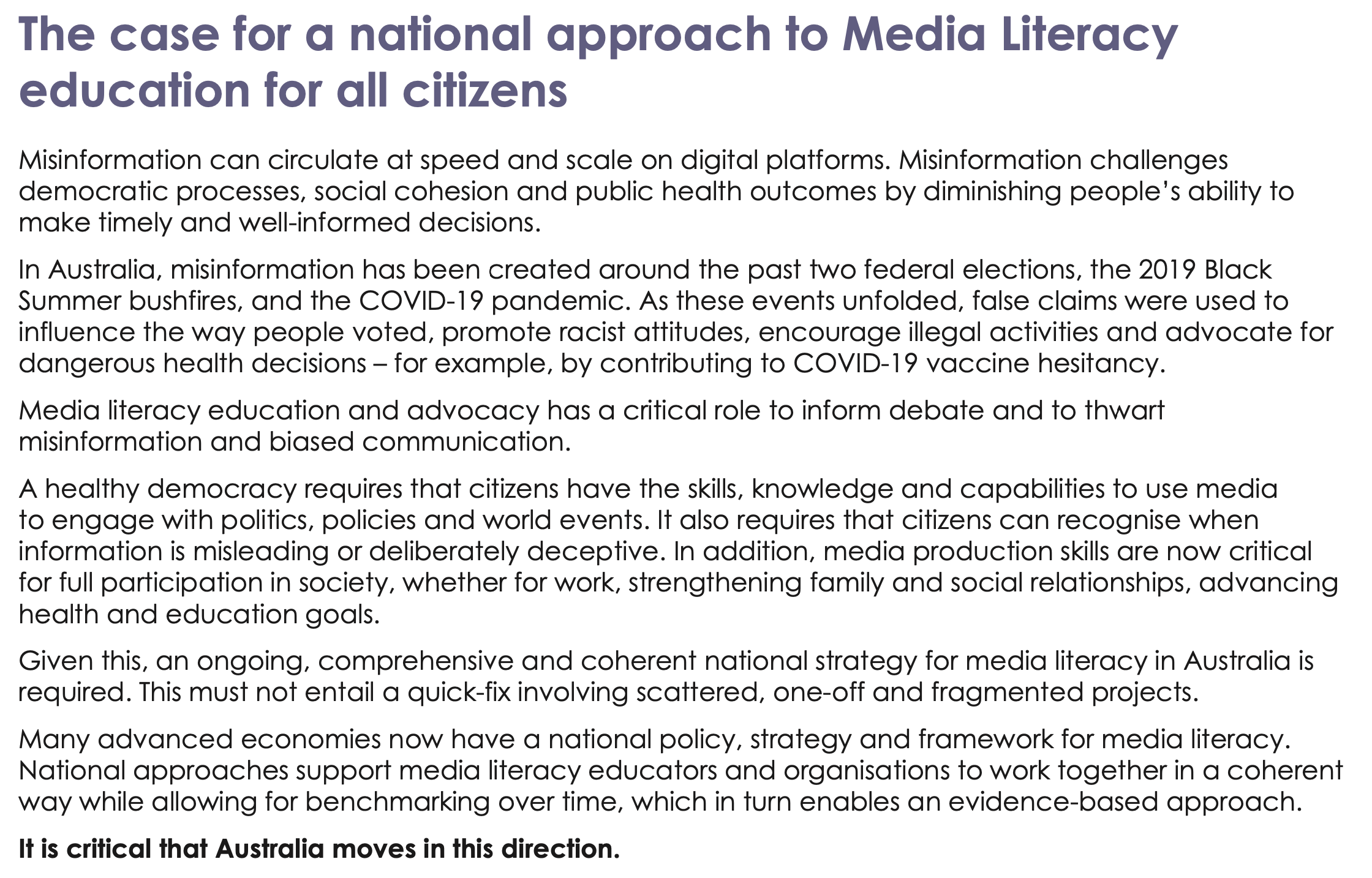
From my engineering background and my experience in disaster response, I know that often it is impossible to prevent something from happening. In those circumstances, the only thing we can really do is mitigate the impact by building resilience – of the people exposed, of the infrastucture involved – and by educating in advance.
This is sometimes referred to as an all-hazards approach: from a disaster recovery perspective, it doesn’t matter whether you have lost your home due to fire or flood, it only matters to the resident that they have lost their home. So, as well as having a bushfire plan to protect your home and prevent damage, you also have to have an emergency plan to help you recover from disasters big and small.
Perhaps we can think the same about fake news: we can’t stop it but we can reduce its impact by educating ourselves and innoculating ourselves against its effects.
#churchillfellow #learnglobally #inspirelocally
 Máiréad Doyle
This is great, Mairead. My connections are getting traction too. Exciting