
The World Economic Forum published its 2025 Global Risks Report last week.
The 2024 report was one of the inspiration points for my application for a Churchill Fellowship.
Interesting to see that misinformation/disinformation and extreme weather events still top the short and long term risk rankings respectively, so no change there.
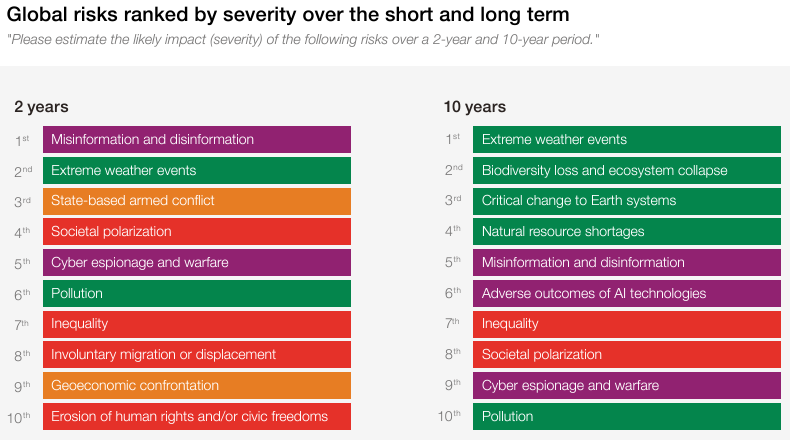
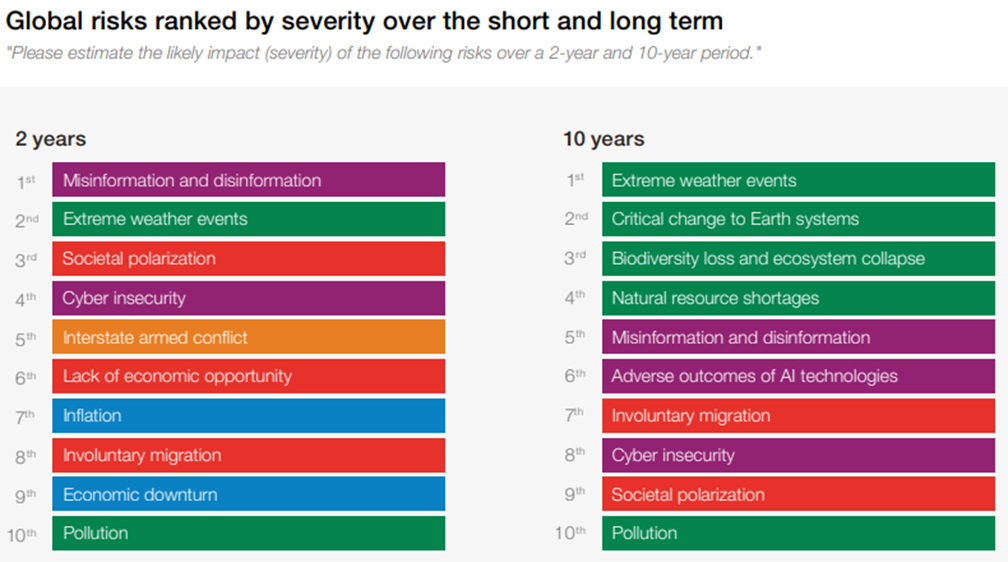
Societal polarisation is edging upwards in both the short-term and longer-term time horizons.
The report states:
“Although there are fewer societal risks in the top 10 of the 10-year risk ranking than in the top 10 of the two-year risk ranking (two compared to four, see Figure C), the profound societal fractures that feature prominently in this report should not be perceived as solely short-term risks. Looking ahead to the next decade, Inequality and Societal polarization continue to feature among the top 10 risks. This is an important pair of risks to watch, given how related they can be to bouts of social instability, and in turn to domestic political and to geostrategic volatility.”
Regarding AI:
“AI technologies is low in the risk ranking. In fact, it has slightly declined in the two-year outlook, with the risk now ranking #31 compared with #29 in last year’s report. However, complacency around the risks of such technologies should be avoided given the fast-paced change in the field of AI and its increasing ubiquity. In this report we highlight how AI models are a factor in the relationship between technology and polarization.” The report goes on to state “Adverse outcomes of AI technologies is one of the risks that climbs the most in the 10-year risk ranking compared to the two-year risk ranking. [This report highlights] the role of Generative AI (GenAI) in producing false or misleading content at scale, and how that relates to societal polarization.”
Finally, regarding elections:
“Respondent concern has remained high following a year of “super elections”, with this risk also a top concern across a majority of age categories and stakeholder groups (Figures 1.6 and 1.7). Moreover, it is becoming more difficult to differentiate between AI- and human-generated Misinformation and disinformation. AI tools are enabling a proliferation in such information in the form of video, images, voice or text. Leading creators of false or misleading content include state actors in some countries.”
It will be interesting to hear the views of my interviewees on this updated view when I travel. I hit India mid-March, the UK and Ireland late March, and the USA the first two weeks of April.
 Máiréad Doyle