
Bruce Schneier first came to my attention through an article he wrote for Wired a few weeks after the 2024 US Presidential election. That led me to an extensive body of work that focuses on cryptography and cybersecurity, but fires some well-aimed missiles at the intersection of AI and elections.
Bruce kindly agreed to meet with me for my Churchill project, at his office at the Harvard Kennedy School.
In a short but fast-paced discussion, Bruce brought his years of experience to bear on the issue of AI, disinformation and elections.
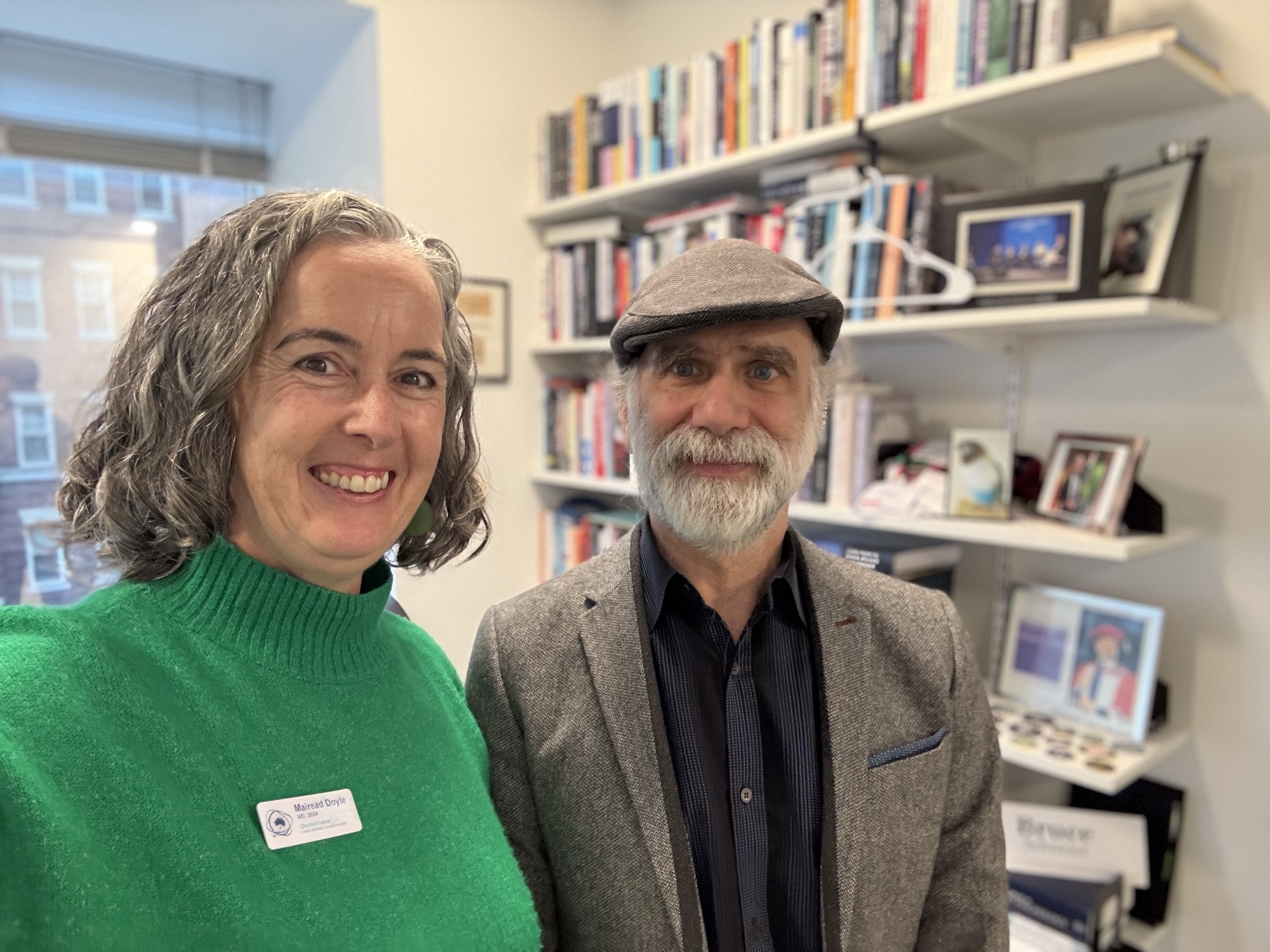
We talked about asymmetry a lot: asymmetry in who uses AI (and disinformation); in an electoral world defined by jurisdictions, now facing a planetary threat; in political power, now openly skewing away from politicians towards those with the money to control things; in the might of the Russian military pitted against a single election official.
Bruce expressed a degree of pessimism about most solutions currently being discussed, noting that the business model of social media platforms was far more influential than any one organisation or jurisdiction to counter – all exacerbated by a world where trust in democracy (in anything) is ever declining. Media literacy in schools, he said, was useful but would solve the problem in twenty years, not now. Similarly, he was quizzical about whether digital provenance tools like C2PA would really make much difference to the risks of AI in the political landscape. We also discussed the notion that monitoring or policing content only during official election timelines is now pointless, as in many jurisdictions the campaign never really stops, making the focus on election time “weirdly arbitrary”, in Bruce’s mind.
I was given real pause for thought when Bruce reminded me that AI is story-driven, not data-driven: it would be better to feed an AI a Jane Austen novel than a bunch of data about morals, because that’s the way AI processes things.
Bruce also introduced me to the Shorenstein Center on Media, Politics & Public Policy and the work of academic Joan Donovan, HKS alum and founder of the Critical Internet Studies Institute. More new rabbit holes waiting for me. All raise interesting discussion points about public interest internet, AI in the newsroom, trust in the media, and what “old” journalism can learn from “new” journalism and individual content creators. Much of this points further to the role – and soft power – of content creators and influencers in the current media landscape. Certainly something to be considered further for my final report.
 Máiréad Doyle