
The U.S. Election Assistance Commission (EAC) is an independent, bipartisan commission dedicated to improving the administration of elections and helping Americans participate in the voting process. I had the pleasure of meeting with Commissioners Donald Palmer, Thomas Hicks, and Benjamin Hovland for an insightful discussion at their headquarters in Washington, DC.
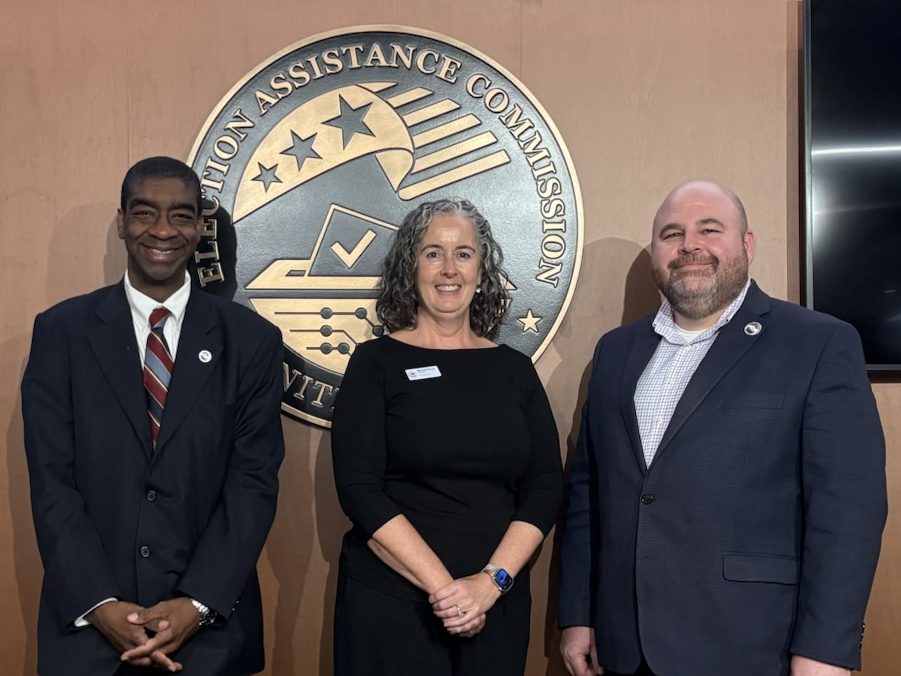
Commissioner Palmer, who joined online, highlighted the rapid advancements in AI and quantum computing, emphasising the challenge of keeping up with new technology standards. He also noted concerns about the impact of regulation of AI-generated content on free speech and the potential for disclosure requirements for AI-generated political ads or activity..
We delved into the potential impact of AI on elections, including the spread of disinformation online. Commissioner Hicks pointed out the difficulty of regulating the internet compared to traditional media like TV. Commissioner Hovland shared that ahead of the 2024 elections, generative AI companies delayed some feature rollouts to avoid becoming the story of the elections. He believes that solutions like pre-bunking and teaching people to identify accurate information are crucial.
Commissioner Hovland also made an interesting point about journalists, noting that those who cover politics often report on election administration with a “horse race lens,” which can be misleading. “Election administration is not the horse race, it’s the track. It’s about having that [track[ smooth, having it taken care of, having it be even, so that the candidates or parties can run their race.”
We discussed the importance of the public having access to trusted sources of information about how to participate in elections, and the usefulness of keeping that separate from campaign information. In the US, the variation in electoral laws and processes across states can create trust issues, and the turnover of election staff exacerbates these challenges. Commissioner Hovland mentioned the “them dynamic,” where people trust their local officials but are sceptical of officials in other places.
The increase in threats and harassment of local officials due to disinformation around the election process was also a topic of concern. Commissioner Hicks voiced concerns about election officials experiencing burnout due to taking on multiple responsibilities, far more than in the past.
They referred to the Reed College 2024 EVIC Local Election Official Survey that showed:
- Job satisfaction stabilising at 77% after declining from 91% in 2020;
- The continuing concerns of increasing workloads, ongoing threats and harassment, and shifting policy requirements;
- Over half of LEOs have faced personal insults, and one-third report harassment, with higher rates in larger jurisdictions;
- Misinformation continues to create challenges for election offices, with 68% of LEOs identifying it as an issue.
Looking ahead to the 2026 elections, the Commissioners hope for high participation and acknowledge the amazing work election officials do across the country. Commissioner Hicks concluded on a poignant note: “That’s what I’m hopeful for. I don’t care who wins, I just care that eligible voters are able to cast their votes and have those votes counted acutely and securely.”
I look forward to reading the EAC’s Election Administration and Voting Survey (EAVS), to be released in June 2025, which will provide valuable insights into the state of American elections.
 Máiréad Doyle